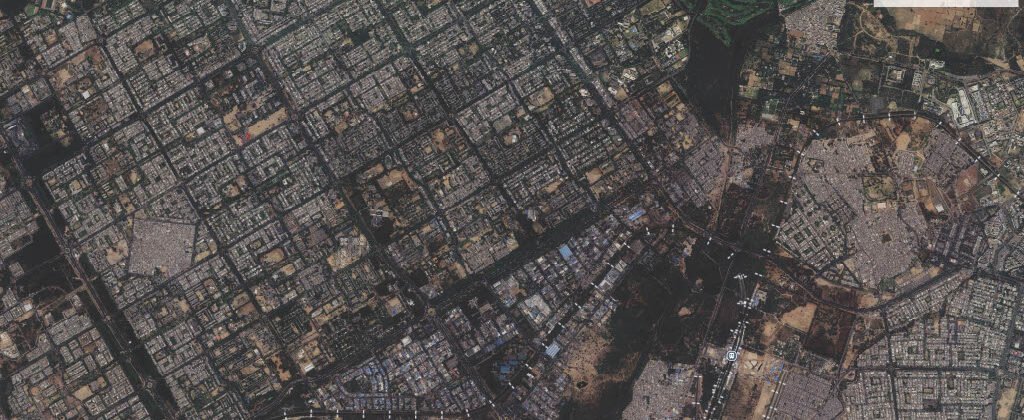
by
by On 15th August 2025, Chandigarh’s UT Administrator announced that 55 acres of land, “freed” by the recent demolitions, including those of slums or bastis[1] would be used for “public welfare projects”, including a 400-bed regional medical hub, solar initiatives, and urban infrastructure upgrades. Reading this in context to multiple demolitions and evictions of urban poor settlements in 2025, a question I keep returning to: Public welfare for whom, if it begins with eviction? The Chandigarh demolitions are not isolated; similar reports have been emerging from other cities such as Delhi and Faridabad, among others. While evictions and demolitions are not new, what is particularly troubling is the correlation between them and the opening up of space for welfare projects, as if the sole reason many such projects were stalled was due to “unauthorised encroachment” on public land.
Drawing from my fieldwork for my MPhil and PhD in Chandigarh, as well as my experience of working with urban poor communities in Mumbai, I ask: if welfare is truly part of the state’s mandate, should those uprooted from the bastis like Janta Colony or Adarsh Colony not also be its beneficiaries? Could these very lands not have been used to provide dignified, affordable housing options for the urban poor instead? Why does welfare for the poor so often translate into eviction, peripheral rehabilitation, or exclusion due to categorization as “ineligible”?
This tension between welfare and exclusion is not new. Chandigarh, imagined as a city of modern planning, carried these contradictions from its inception. To understand why demolitions today are framed as “public welfare”, we must revisit the founding vision of the city itself.
Planning for Some, Excluding Many
After the demolitions in 2025, headlines proudly proclaimed that “acres of government land worth crores have been freed from encroachment.[2]” This language provoked me to revisit the Statute of Land, the 1959 document prepared by Le Corbusier that laid down the foundational planning principles for Chandigarh. Among its declarations are two seemingly contradictory ideas:
“(i) Chandigarh is a city offering all amenities to the poorest of the poor of its citizens to land and dignified life”.
(ii) Chandigarh is a government city with a precise goal and consequently a precise quality of inhabitants.” (Sagar, 2009, pg. 85[3]; Sarin, 1982; p.51[4])
I first came across this during my MPhil research, and I was both impressed and conflicted after reading it. On the one hand, it was progressive through its inclusivity for the poorest of the poor. At the same time, it defined the “precise quality” of who was a resident of the city, i.e., primarily government employees and partition-displaced families. As I argued in my MPhil dissertation[5] (and later at the RC21 Conference[6] 2015), the phrase “poorest of the poor” was effectively limited to the lowest rungs of government service, while informal workers, migrants, and the wider urban poor were left outside this vision altogether.
This exclusion was material as well as conceptual. While a large number of houses were built for government employees, almost 70 percent of the city’s land was auctioned as private plots (Evenson, 1966[7]), immediately making it unaffordable for the working-class poor. As Charles Correa[8] later observed, citing Ved Prakash’s early analysis: “the real cross-subsidy in Chandigarh is of the poor subsidizing for the rich.. right from the start, the cost of housing and basic services climbed out of reach of the poor” (Correa, 2009 as cited in Khan, Beinart, and Correa, p.144-145).
Thus, from the beginning, this contradiction structured Chandigarh’s planning and concretely shaped who the city was built for and who it was not.
Demolitions as a Mode of Governance
This contradiction has continued to structure the tensions between planned and “non-planned[9]” spaces in Chandigarh since its inception. In 2025, newspaper reports detailed the demolition of Janta Colony[10], Sanjay Colony[11], and Adarsh Colony[12] situated in residential and industrial zones of the city. These bastis were home to working-class families priced out of the formal housing market. These were not just houses without a history, but spaces of cohabitation, social bonds, and commercial enterprises that developed over time. Spaces where the Basti residents had gradually built a life alongside the surrounding planned areas, finding work and education for their children, among other things.
A recent guest column[13] in the Hindustan Times rightly noted that Chandigarh’s demolitions reflect a longstanding friction between its planned, high-modernist vision and the realities of informal habitation. The article calls for more compassionate urbanism, including in-situ rehabilitation and affordable rental housing. While I agree with these concerns, my engagement with this critique takes it further. By revisiting the foundational planning documents and examining demolition outcomes on the ground, including evidence from Sanjay Colony and earlier evictions, I argue that the problem lies not just in execution, but in the very logic of a “slum-free” city.
Below is a Google Earth image comparison of Sanjay Colony in the Industrial Area of Chandigarh documenting its presence before eviction and its erasure after demolition in 2025. This visual captures how working-class neighbourhoods are rendered invisible in narratives that celebrate “reclaiming” land without any clarity on inclusive reuse or long-term resettlement.
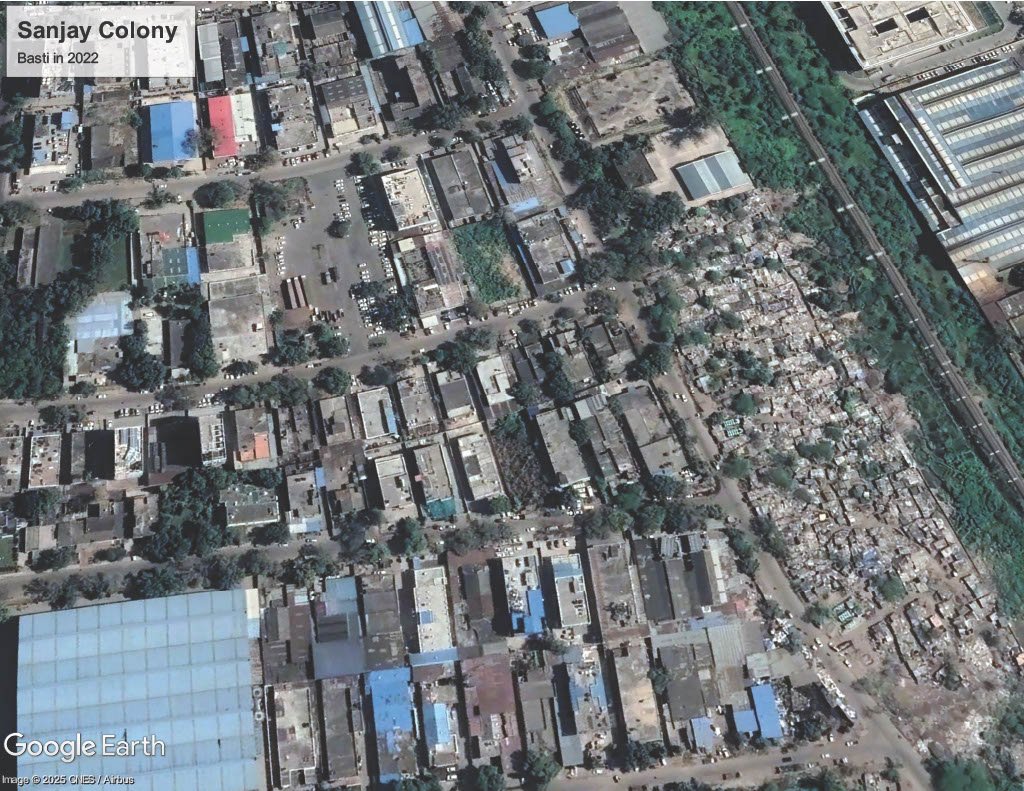
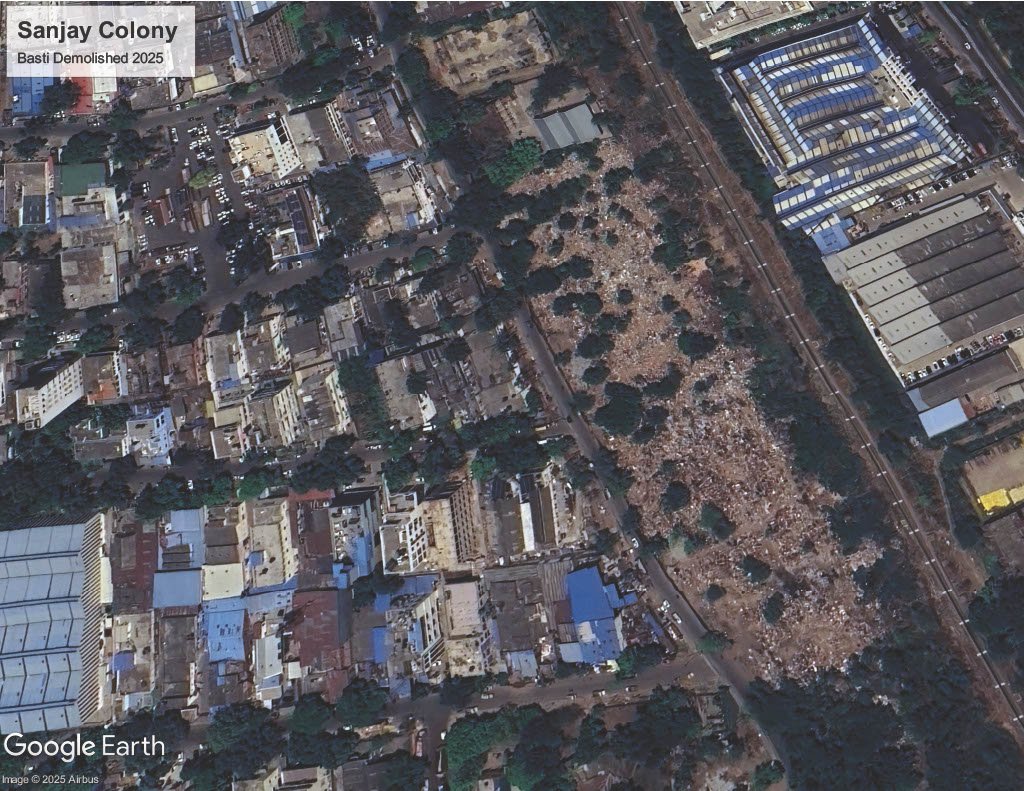


The idea of a “slum-free city” does not merely remove settlements; it reshapes how development itself is imagined. Once the bastis are erased, the language of planning quickly shifts to promises of new projects, schemes, and “public use” of the land. Yet, as Chandigarh’s history shows, these promises are far from straightforward; they often exclude the very communities displaced in the process.
Development for Whom?
Before the UT Administrator’s address on Independence Day, Chandigarh Housing Board (CHB) had already proposed housing schemes for some of these “freed” lands, which include an option for an Economically Weaker Section (EWS) flat priced at ₹74 lakhs[14]. But it raises an obvious question: does CHB believe that daily-wage workers, sanitation staff, or domestic workers can afford such prices? By design, such a proposal is flawed. It equates inclusion with technical provision, while making access structurally impossible. This is not the first time Chandigarh has promised development after eviction and failed to deliver.
One only has to look at the city’s track record to question the promised post-eviction “development.” For example, below is a Google Earth satellite imagery comparison of an urban poor basti, Colony Number 5, as of October 2013, and a few months later in February 2014, after it’s demolition in November 2013[15].
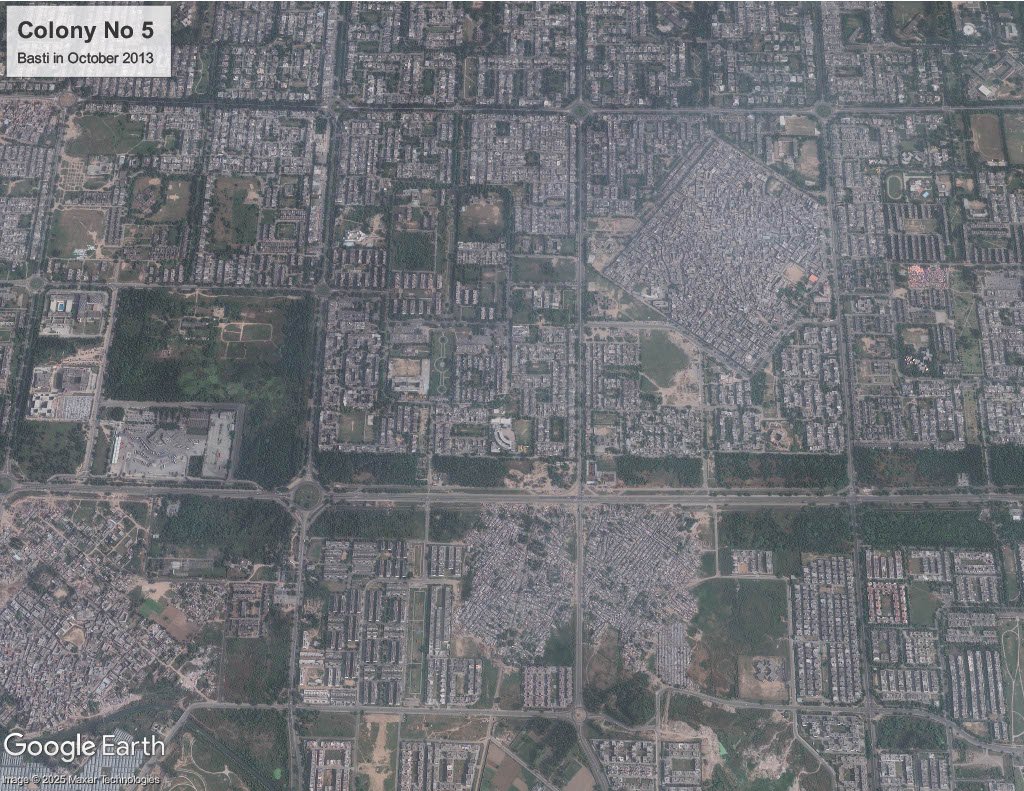
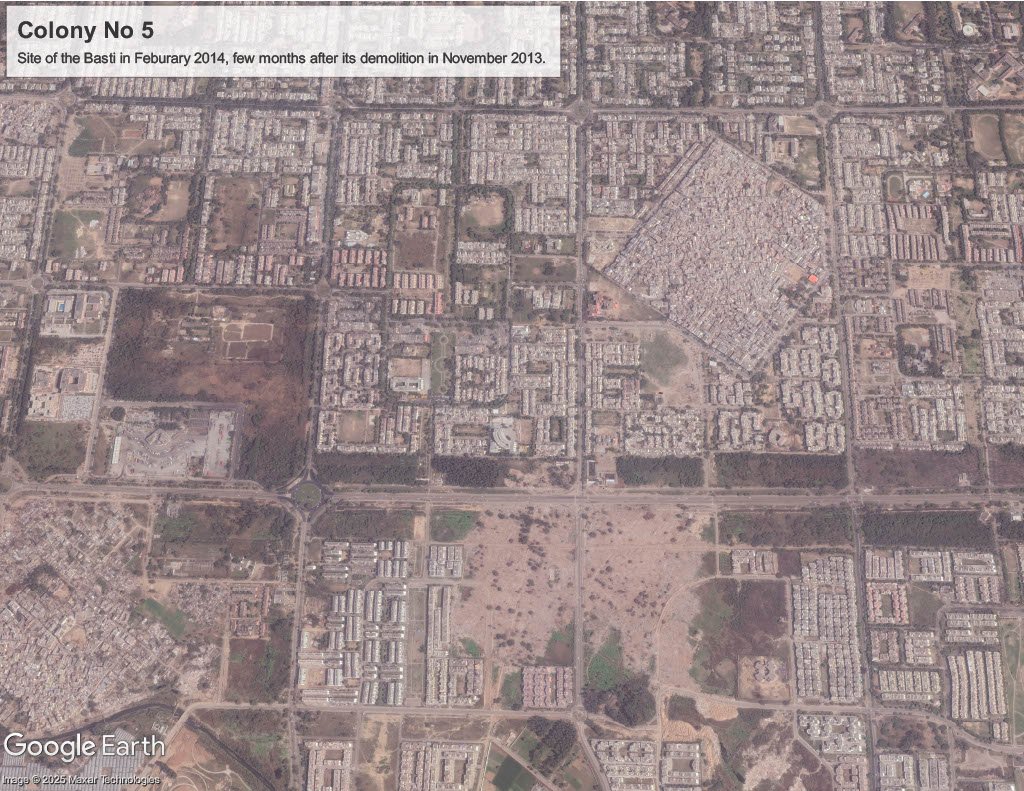


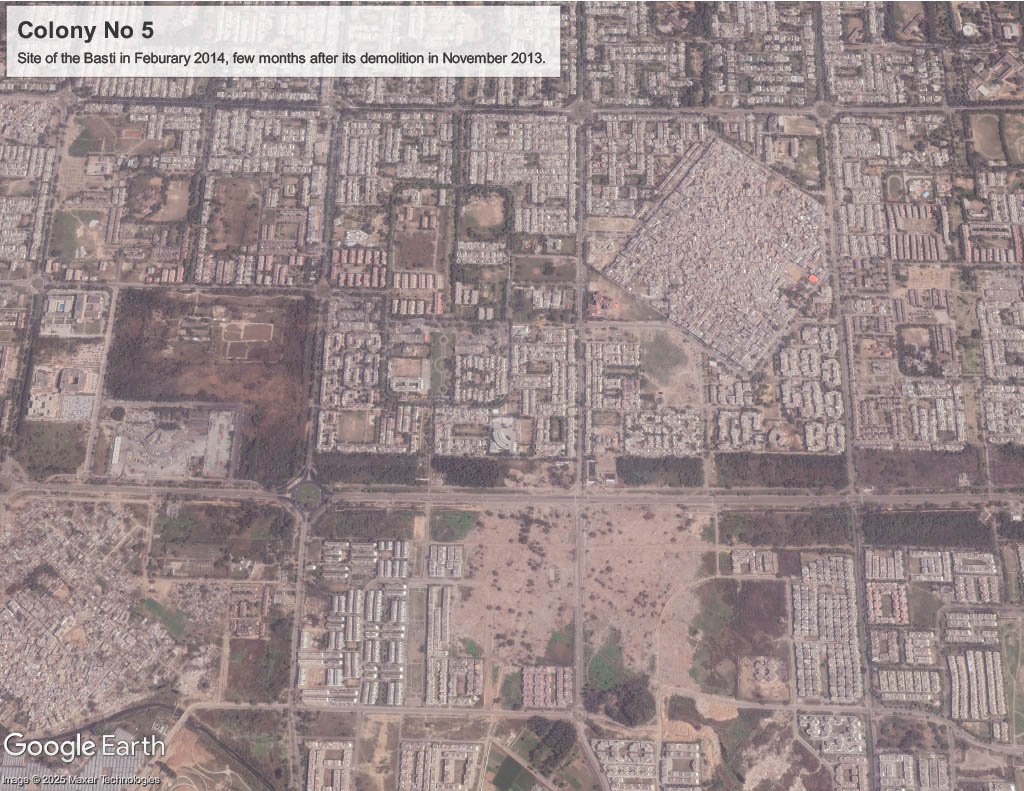
Over a decade later, even after reports of proposed developments on this vacated land, such as the development of the third campus of Panjab University,[16] the land lies vacant. The absence of public housing or civic infrastructure here challenges the very logic that justified the eviction. Was the land really needed, or was the erasure itself the goal? The Google Earth imagery comparison (site of Colony No. 5 in February 2014 and site of Colony No. 5 in September 2025) below shows the undeveloped land parcel even a decade after the colony was demolished. A stark reminder that eviction does not guarantee public use or equitable development.
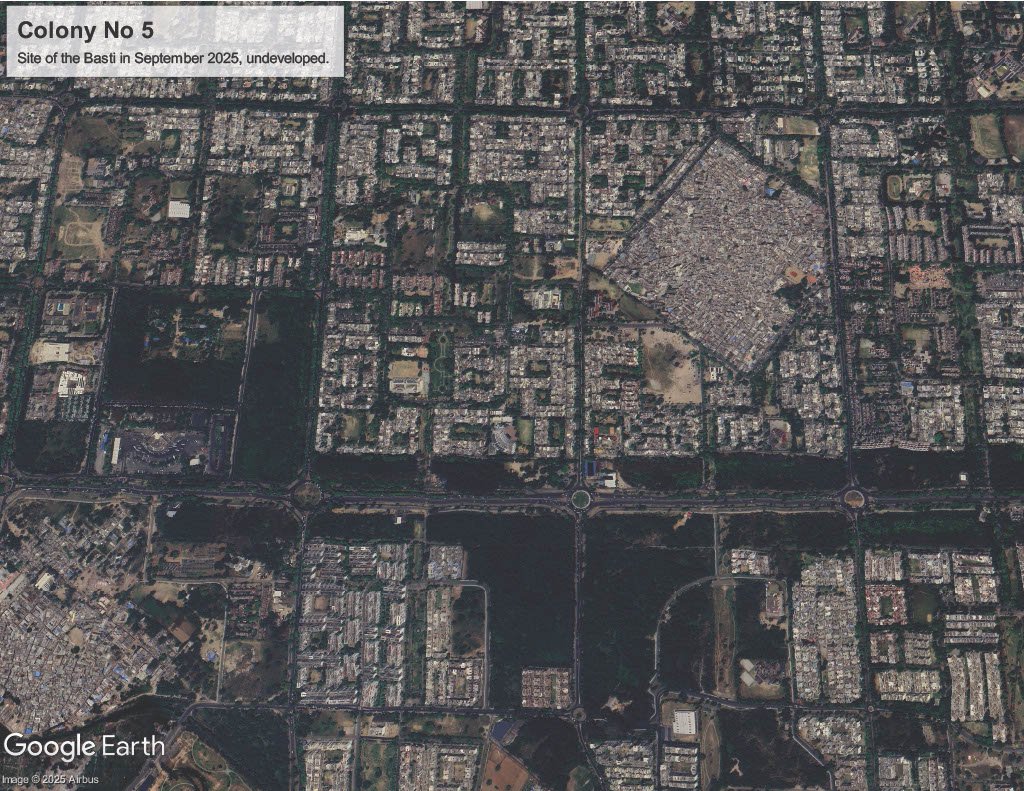


These failures point to a deeper question: who is the development really for, and who gets to belong in the city’s future? The politics of eligibility makes this exclusion stark.
The Politics of Eligibility: Who Gets to Belong?
Since 2013, multiple bastis in the city have been demolished[17]. Even before this, phased evictions and rehabilitation measures were implemented for various bastis. The Small Flats Schemes, 2006, launched as a part of the Jawaharlal Nehru National Urban Renewal Mission (JNNURM), was imagined and implemented as a massive exercise to clear the city of slums and move the residents of these slums into rehabilitation sites located on the periphery of the city in Dhanas, Maloya, etc. In this blog, I do not want to elaborate on this scheme and its shortcomings; however, this exercise that began with the vision to create a Slum-Free City categorized the residents of these bastis as “eligible” or “ineligible” based on a biometric survey conducted across the city.
The question that emerges after each demolition, such as the one conducted in 2025, is what happens to the families displaced by these demolitions? Newspaper reports suggest that some were deemed “eligible” for resettlement in the different rehabilitation sites of the city. But many, particularly from Adarsh Colony, were left homeless[18]. Alongside their homes, what was also destroyed was a living history, informal settlements built over decades, networks of care, community resilience, and the cultural life of working-class Chandigarh. The politics behind proving eligibility and proof of residence for housing and tenure security has been highlighted by researchers and activists across the country. Therefore, those who were categorized as not eligible what happens to them[19]?
The repeated categorization of families as ‘eligible’ or ‘ineligible’ is not accidental, but tied to how the very idea of a ‘slum-free city’ has been framed in national policy discourse.
Why ‘Slum-Free’ Fails the City?
The term “slum-free city”, popularized under various urban development missions and schemes like JNNURM, RAY, Smart Cities Mission, and PMAY-U, is dangerously static: it equates a city without bastis to a city without slums, ignoring the lived realities of urban precarity and, in turn, moving towards verticalization of slums. Urban Local Bodies (ULBs) and States across the country, while implementing these slum-free city mandates, increasingly adopt an approach of removing slums, shifting “eligible beneficiaries” to flats either built under government schemes, such as in the case of Chandigarh, or built by private developers, like in Mumbai. However, I ask, does the erasure of slums actually erase the conditions that make a human habitation or settlement slum like?
Drawing from my work with resettled communities in Mumbai, I have seen how vertical resettlement schemes often produce the very conditions they claim to eliminate. In place of bastis, which allowed some degree of autonomy and social life, families are moved into towers with poor ventilation, failing infrastructure, and social isolation. Scholars describe these as “vertical slums” where form changes, but deprivation remains.
Yet Chandigarh’s own history offers examples that resist this logic. Bhaskar Colony stands as evidence that alternatives to erasure and verticalization are possible.
Learning from Bhaskar Colony: An Inclusive Alternative
For my MPhil research in Chandigarh, I studied Bhaskar Colony[20], an in-situ rehabilitation initiative where Basti residents were allotted serviced plots on which they could build incrementally. While the plan for the house was provided, residents had the flexibility to build incrementally with whatever resources they could mobilize. The option of adding floors also meant that multi-generational or expanding families could remain together, preserving kinship networks often fractured in peripheral locations. While challenges around eligibility, construction norms, and amenities persisted, Bhaskar colony demonstrated that intent matters. It showed that humane, inclusive alternatives to peripheral relocation and vertical towers are possible and have already been implemented in Chandigarh itself. Its example reminds us that the city had the tools to pursue inclusive welfare all along, making today’s exclusions not inevitable, but political choices.
Conclusion: From Erasure to the Right to the City
The recent demolitions and the Independence Day promise of “public welfare projects” reveal a troubling shift. Welfare, once imagined as inclusion, is increasingly practiced as erasure or as peripheral rehabilitation.
A humane and inclusive city is not one without slums, but one where no one is forced to live in slum-like conditions. Chandigarh once held the promise of modelling such an approach. Today, it must choose whether its future will continue this trajectory of exclusion or reclaim its forgotten promise of welfare for all.
[1] Drawing from Gautan Bhan’s 2017 article Where is Citizenship?: Thoughts from the Basti published in the Journal of Comparative Studies of South Asia, Africa, and the Middle East, I prefer the term Basti as it offers a sense of gradual habitation and building of socio-economic bonds within the settlement as well as the city.
[2] 12 acres freed as Chandigarh Admn razes Adarsh Colony
[3] Sagar, J (2009). Administering Chandigarh: Looking Back. In H-U. Khan, J. Beinart, & C. Correa (Eds.), Le
Corbusier: Chandigarh and the Modern City (pp.80-96). Ahmedabad: Mapin Publishing Pvt. Ltd.
[4] Sarin, M. (1982). Urban Planning in the Third World: The Chandigarh Experience. London: Mansell Publications
[5] Bhardwaj, R. (2014). Exploring Urban Inclusion: Spatial Planning and Urban Poor in Chandigarh. Mumbai: Tata Institute of Social Sciences
[6] Bhardwaj, R. (2015, August 27-29). Assertions of the Urban Poor towards Inclusion in cities of Global South: Challenging the Spatial Plan in Chandigarh, India [Conference Presentation]. RC21 2015, Urbino, Italy.
[7] Evenson, N. (1966). Chandigarh. Berkeley and Los Angeles: University of California.
[8] Correa, C. (2009). What we learned. In H-U. Khan, J. Beinart, & C. Correa (Eds.), Le Corbusier: Chandigarh and the Modern City (pp.80-96). Ahmedabad: Mapin Publishing Pvt. Ltd.
[9] Madhu Sarin (1982) used this term to denote the informal settlements and markets that gradually took shape in Chandigarh within the plan area but were not factored in while making the formal plan.
[10] Chandigarh’s last big slum, Janta Colony, to be razed today
[11] Existing for over 2 decades, Sanjay Colony in Chandigarh demolished
[12] Adarsh Colony Raised, Chandigarh administration considers declaring city ‘slum-free’
[13] Chandigarh’s slum demolitions: Urban order or displacement dilemma?
[14] CHB plans 1,000-flat project on 32 acres in Sector 54
[15] UT erases Colony No. 5 from its soil
[16] Colony No. 5 land may go to Panjab University for its third campus
[17] Slumisation of Chandigarh: A bugbear that’s hard to tame
[18] Illegal Shanties in Adarsh Colony: Tens of thousands rendered homeless in UT admn’s demolition action to reclaim 12 acres
[19] The residents of Adarsh colony deemed ineligible ask what do they do, Indian Express article ‘We are left on road.. there is nowhere to go’: Residents share plight as hope disappears, highlights the challenges faced by the people after the demolition drive.
[20] To read more about this, refer to my paper Bhardwaj, R. (2015, August 27-29). Assertions of the Urban Poor towards Inclusion in cities of Global South: Challenging the Spatial Plan in Chandigarh, India[Conference Presentation]. RC21 2015, Urbino, Italy.